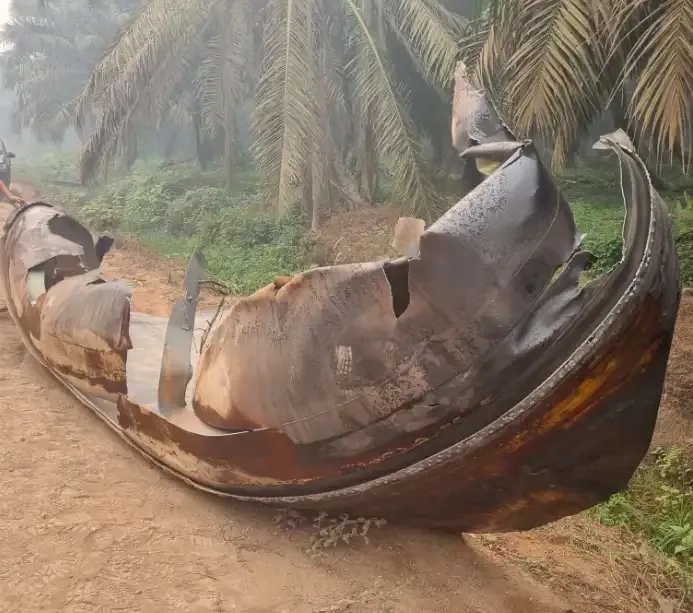
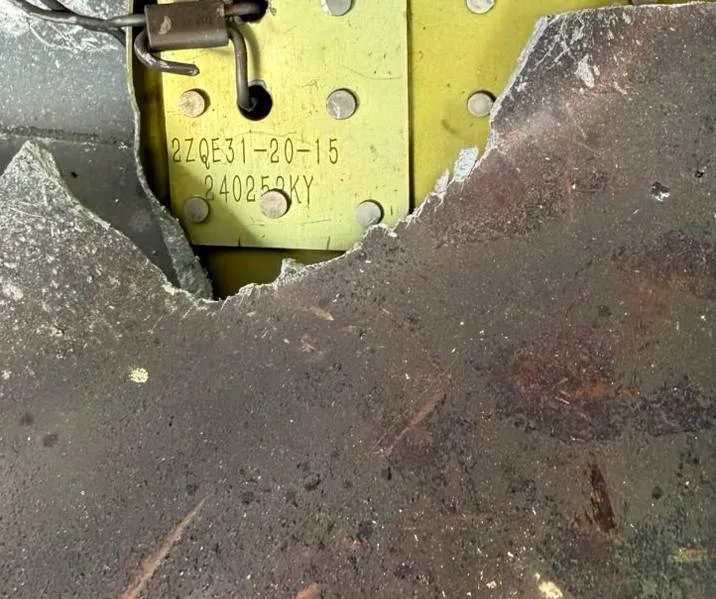
Plantation workers in Sampit, in Indonesia’s Central Kalimantan province on Borneo, found a large, torn piece of metal among the oil palms on the morning of Monday 19 October. Residents had heard a rumble from the sky at about 17:30 local time (10:30 UTC), late the afternoon before. Indonesia’s National Research and Innovation Agency, BRIN, says the piece is most likely space debris from the spent Zhuque-2E, a Chinese rocket that fell back into the atmosphere on Sunday 18 October.
In this Article
- Zhuque-2E upper stage
Satellite
The last pass over Borneo
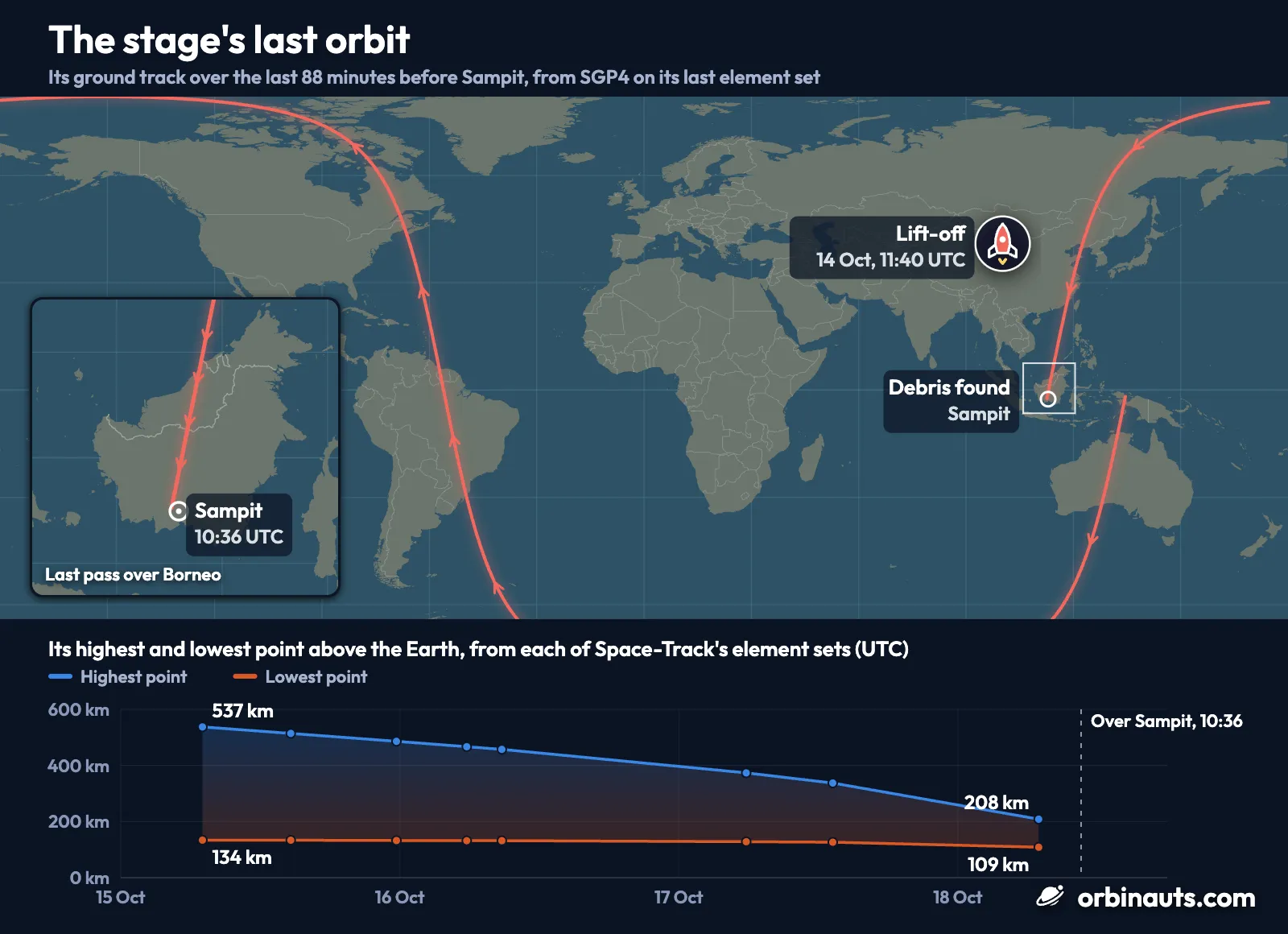
BRIN made its initial identification from the orbits of the objects expected over Kalimantan at the time. It found the spent rocket crossing Kalimantan from north to south on 18 October and passing near Sampit at about 17:36 local time (10:36 UTC), on what BRIN says was its last orbit before it re-entered. “This time matches the reports of residents who heard the rumble that afternoon,” said Thomas Djamaluddin, a principal researcher in astronomy and astrophysics at BRIN. BRIN names the object as NORAD 101070, international designator 2026-234L.
Our own numbers agree on the track and the time. Our Re-entries list the re-entry of 2026-234L, ZQ-2E R/B, the rocket’s upper stage, on 18 October, with its last Elements, from 06:56 UTC that morning: an orbit 109 km above the Earth at its lowest and 208 km at its highest. Run forward with SGP4, the standard model for such Elements, they put the stage on a southbound track across Borneo and about 41 km west of Sampit at 10:36 UTC, the same minute as BRIN’s. What the model cannot tell is where an orbit that low finally gave way: run on, it still has the stage circling after Sampit. That this pass was the last rests on BRIN’s analysis. Space-Track, the US Space Force’s public catalogue, dates the re-entry to the day alone, and has issued no forecast message for it.
A stage left low
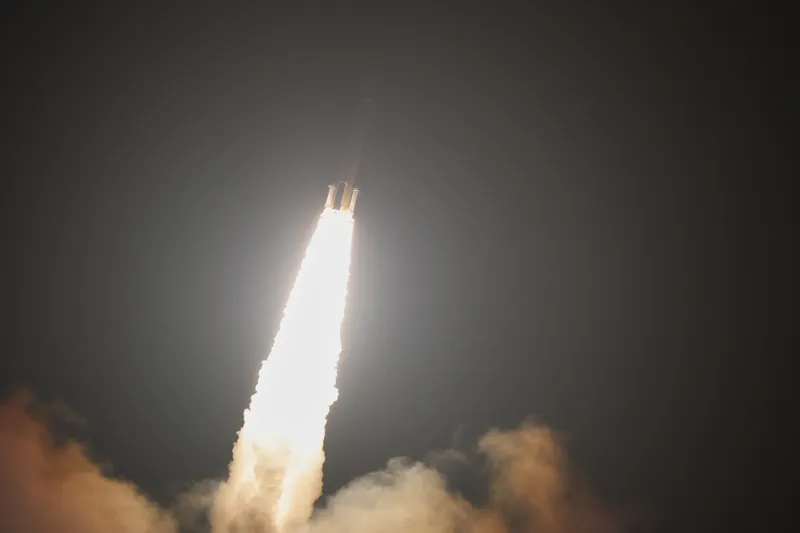
LandSpace’s Zhuque-2E Y4 lifted off at 19:40 Beijing time on 14 October (11:40 UTC) from the Dongfeng commercial space test zone in northwest China, on the tenth flight of the Zhuque-2 family, and put ten satellites into their planned orbits: eight for ADA Space, built to test computing in orbit, and two laser-link test satellites built by Lanta Intelligent, through which LandSpace is building up satellite networks. The rocket has two stages and burns liquid methane and liquid oxygen, BRIN notes.
Its upper stage was left in an orbit that dipped low enough to bring it down within days. A spent stage can stay in orbit for a while after its work is done, until the drag of the atmosphere lowers it into re-entry, as Djamaluddin put it. Space-Track’s Elements show that drag at work: between 15 and 18 October the stage’s highest point fell from 537 km to 208 km, while its lowest stayed between 134 and 109 km.
We wrote about the launch, and about the low orbit the stage was left in, two days before it fell.
 Read nextChina tests how to keep powerful computers cool in orbit, on eight satellites that will barely see night
Burnt, torn, and to be checked
Most of a stage burns up, melts or breaks apart in the heat of re-entry, but parts made of more heat-resistant material can survive to the ground, Djamaluddin said, and the shock waves can be heard on the ground as a boom or a rumble. BRIN’s case rests on the orbit and the timing. It says a physical examination is still needed to confirm what the piece is, matching its shape, its material and the markings on it against the rocket’s technical details.