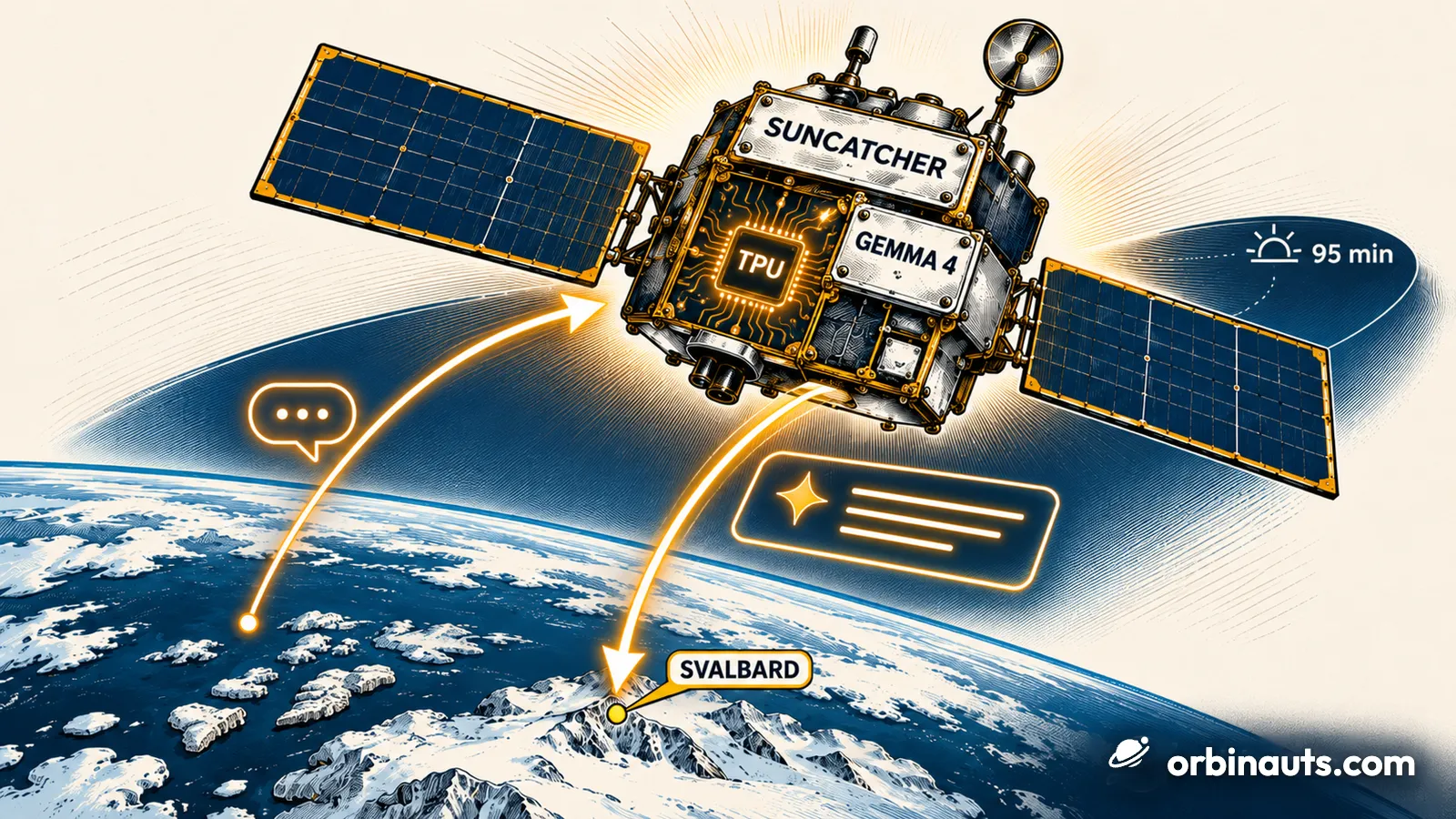
Google’s AI satellite has answered its first prompt. On 30 October, the company said that during a ground-station pass its team had uplinked a prompt to the Gemma 4 open model on board the Project Suncatcher prototype, asking it for a haiku about being in space. The poem came down as the satellite passed by Svalbard, Norway: “Blue marble below / Data streams in silent grace / Starlight feeds my core.”
In this Article
- Project Suncatcher M1
Satellite
Google calls it the mission’s “Hello World” milestone, after the first line programmers make a new machine print. The satellite launched on 1 October, and the team has since worked through its commissioning checklist, powering up the host and TPU trays and running early machine learning tests. TPUs, or Tensor Processing Units, are Google’s own AI hardware. After the haiku came space-themed limericks, and prompts asking the payload to report its own technical status.
A first for Google’s data-centre chips
Google describes the poem as the first-ever AI response from a data center class TPU in orbit: a chip of the kind it runs in its data centres on Earth. That makes it a first for Google’s data-centre TPUs, not for data-centre chips in space. Starcloud, a company that wants to build data centres in orbit, launched its Starcloud-1 satellite in November 2025 with an Nvidia H100 GPU, and says that in December 2025 it ran a version of a Google AI model there and trained a small language model, Andrej Karpathy’s nanoGPT.
Next: heat and radiation
Still ahead are the tests that will evaluate how the TPUs perform under thermal stress and radiation exposure in orbit. Showing that they can reliably run workloads in space, Google says, paves the way for its next milestone, two interconnected satellites in 2027.
In and out of sunlight
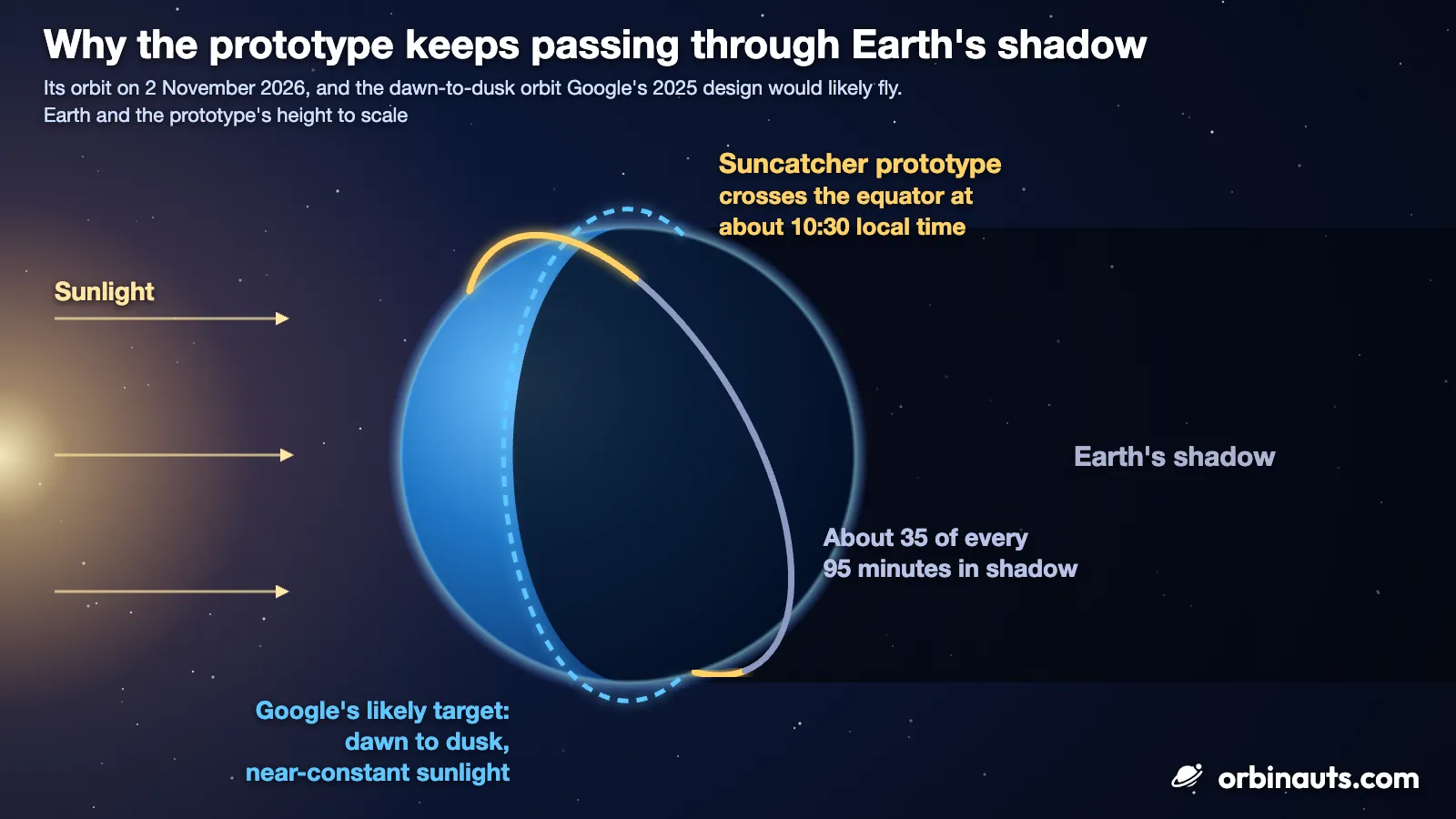
The prototype does not fly the kind of orbit Google has in mind for the real thing. The constellation it sketched in November 2025 would likely fly a dawn-to-dusk sun-synchronous orbit, exposed to near-constant sunlight. The prototype, by our calculation from its latest element set, circles the Earth every 95 minutes between about 516 and 544 km up, on a sun-synchronous orbit that crosses the equator heading south at about 10:30 in the morning, local time. That takes it through Earth’s shadow for about 35 minutes of every orbit.
How Google tested the chips on the ground before launch, and why it wants to put AI in orbit at all, is in our Article on the launch.
 Read nextGoogle wants to know if AI data centres can work in space. Step one is now in orbit: a satellite testing whether its AI chips survive
How we worked it out
Our figures come from the satellite’s public orbit data (Catalogue number 100902), published by Space-Track, the US Space Force’s catalogue, as it stood on 1 November 2026 at 22:41 UTC. From it we worked out its path over 2 November: its height, how long each orbit takes, when it crosses the equator and how long it spends in Earth’s shadow. They are our estimates, not Google’s figures. The satellite can be followed on the live map.