The partners in the International Space Station have decided to leave the PrK, the small transfer tunnel at the back of the Russian Zvezda module, permanently closed because of an air leak that cannot be stopped, Russianspaceweb reported on its 2026 page, last updated on 31 October. The site is the work of Anatoly Zak, a Moscow-born journalist who has covered the Russian space programme since the early 1990s, when he reported for the Moscow daily Nezavisimaya Gazeta. The public part of its page names no source, and neither NASA nor Roscosmos has announced the decision. But it matches what two NASA officials, speaking on background, told Ars Technica’s senior space editor, Eric Berger, in June: that Russia would decommission the tunnel.
In this Article
- International Space Station
Space station
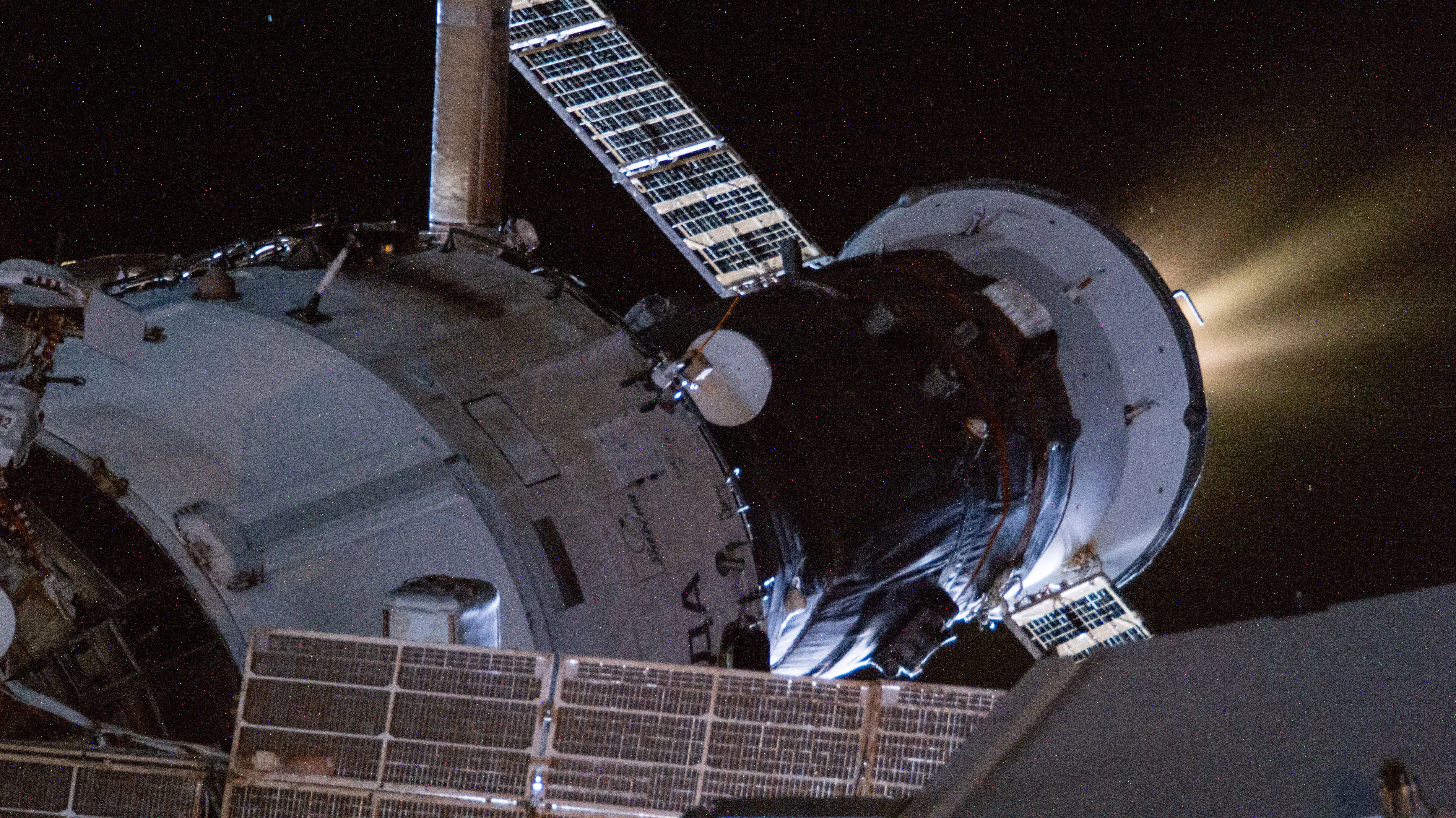
The PrK is the short passage between Zvezda and the docking port at the station’s rear. That port receives Progress ships, Roscosmos’s uncrewed cargo ships, which each bring about three tons of food, fuel and supplies and leave months later full of rubbish to burn up in the atmosphere. To reach one and unload it, cosmonauts had to fill the tunnel with air, and its cracks leak each time the pressure goes up or down. A Progress at that port has a second job: it fires its engines to raise the station’s orbit, as Progress 91 is doing in the picture above.
Two ports for every cargo ship
According to Russianspaceweb, the first ship to work the new way will be Progress MS-36 (Progress 97 in NASA’s numbering), which a Soyuz rocket is to launch from Baikonur on 24 November for a docking at the Poisk module on the 26th. Its cargo will be unloaded through Poisk’s open hatches. The ship will then move to the aft port, the best place to fire its engines because there they line up with the station’s main axis, though that port no longer gives a way into its cargo section. From then on this will be the rule: essentially every Progress will dock twice, once to unload and once to raise the station, until the station is deorbited as planned.
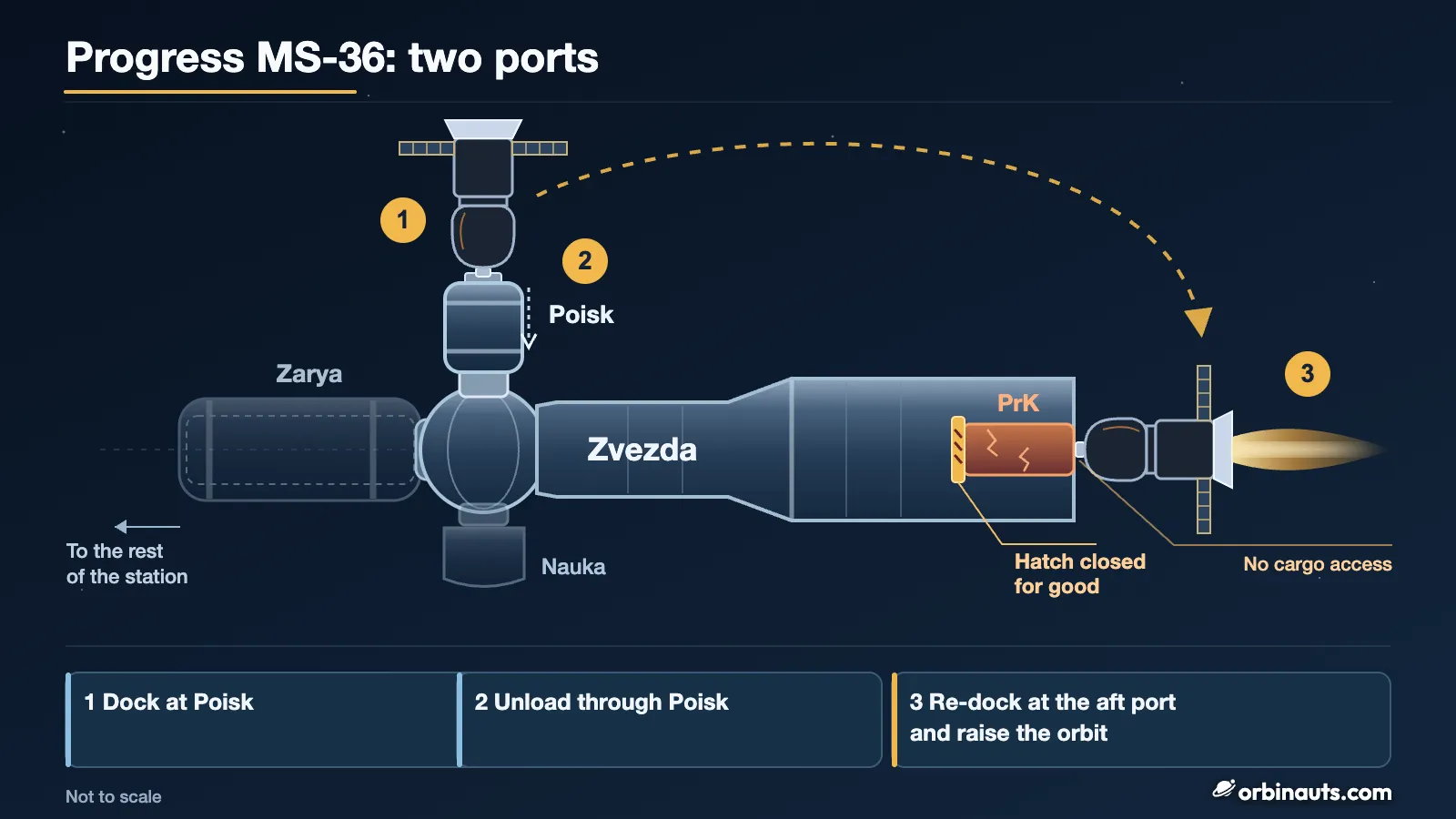
As the NASA officials described it, cosmonauts would no longer enter the PrK or try to pressurise it; Progress ships could still use its port to transfer fluids or for other work, and Russia would need other ports to bring supplies aboard. For NASA, that should retire the risk of a rapid depressurisation it had reluctantly accepted for years.
How it came to this
The PrK has had cracks since 2019 that let small amounts of air escape, and Roscosmos has applied temporary and permanent sealants to them. In the week of 1 June, while Progress 95’s cargo was being handled, Roscosmos saw the leak rise to about 0.9 kg (two pounds) a day, and found new places it suspected were leaking.
On 5 June, Roscosmos said that its flight controllers had seen the leak when the PrK was brought up to the station’s pressure, and that the cosmonauts had found two places where air might be escaping. They sealed the first with Germetall-1, a two-part sealant, and were getting ready to seal the second, on the tunnel’s conical section. The same morning Roscosmos chose a more extensive inspection and structural repair: cutting a bracket, in a way that NASA said could have raised the risk to the structure. NASA sent the four members of Crew-12 and astronaut Chris Williams into the SpaceX Dragon as a safe haven. Later that morning Roscosmos paused the repair to take more measurements, which NASA strongly supported, and the crew went back to normal work. In its statement, posted after they had left the Dragon, Roscosmos said the crew and the station’s systems had not been at risk and that the pressure aboard was stable.
The cracks come from corrosion, and the new ones found in early June brought them to about 16.
Where the ships are now
In mid-October both ports MS-36 is to use were taken: NASA counted Progress 95 and 96 at the station. Progress 95 (MS-34 in Russia’s numbering) docked to Zvezda’s aft port on 27 April to stay about six months, a stay that ran out at the end of October; NASA has not reported it leaving. Progress 96 (MS-35) docked to Poisk on 19 September to stay about five months. Russianspaceweb lists Progress MS-37 for launch on 2 December, a week after MS-36. Neither NASA nor Russianspaceweb has said how the ships will be moved before 26 November.
Who keeps the station up
Whichever ports the ships end up on, the station has to be raised again and again. Progress ships are not the only ones that do it: Northrop Grumman’s Cygnus XL raised it on 27 August, firing its thrusters for 20 minutes 43 seconds, and again on 25 September, for 18 minutes. According to Orbinauts, the average altitude of the ISS has dropped about 1.4 km in the five weeks since its last raise at the end of September, and on 2 November the station orbits between 415 and 425 km above the Earth.