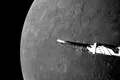
Where is BepiColombo now?
positions of this minuteBepiColombo is in orbit around Mercury, 160 million km from Earth and 53 million km from the Sun, on NASA JPL’s predicted path for . A radio signal from Earth takes 8 min 53 s to reach it.
Lunar Reconnaissance Orbiter
NASA · In orbit around the Moon
Above the Moon right now
72 km
Moving at 6,000 km/h relative to the Moon, coming down
Farthest point of this lap
110 km up
about 18:46 UTC on November 23
Next close pass
70 km above the surface
about 17:48 UTC on November 23
One lap takes
1 h 57 min
Seen from the Sun’s side, at the angle that shows every orbit open. True scale: the Moon is 3,470 km across.
- journey since launch
- latest part of the journey
- working
- silent
- Earth
- LRO’s orbit
- the other spacecraft’s orbits
Positions for , worked out from NASA JPL’s predicted paths. How this is worked out
Predicted: NASA JPL’s paths. Positions for .
- From the Sun
- Speed round the Sun
Next
Above Mercury right now
Farthest point of this lap
Next close pass
One lap takes
The journey so far
BepiColombo launched on October 20, 2018 and flew past planets 9 times on the way, using each pass to change its speed and course.
Launch
Source: ESAOn an Ariane 5 from Kourou, French Guiana: ESA’s orbiter and JAXA’s Mio stacked on a transfer module that carried them most of the way.
Flyby of Earth
Source: ESAFlyby of Venus, 1 of 2
Source: ESAFlyby of Venus, 2 of 2
Source: ESAFlyby of Mercury, 1 of 6
Source: ESAFlyby of Mercury, 2 of 6
Source: ESAFlyby of Mercury, 3 of 6
Source: ESAFlyby of Mercury, 4 of 6
Source: ESAFlyby of Mercury, 5 of 6
Source: ESAFlyby of Mercury, 6 of 6
Source: ESAArrival at Mercury
Source: ESAInto orbit round Mercury on this day, the two orbiters still joined; ESA confirmed it the next day, once the spacecraft’s signal came back after its orbit insertion burn. NASA JPL’s predicted path has it on a long loop round the planet since that evening.
What happens next
What BepiColombo is there to do
BepiColombo is two spacecraft travelling as one. ESA’s Mercury Planetary Orbiter (MPO) is there to image and map Mercury; JAXA’s Mercury Magnetospheric Orbiter, Mio, to study the magnetic field and the space round the planet. Each works from an orbit of its own. ESA
Once apart, Mio flies a polar orbit 590 to 11,640 km above the surface, once every 9.3 hours. ESA’s orbiter goes lower, 480 to 1,500 km up, once every 2.3 hours. ESA
Its science is planned to begin in April 2027, for a mission of one year to start with. ESA
Questions people ask
How far is BepiColombo from Earth?
160 million km at 17:35 UTC on November 23, 2026, on NASA JPL’s predicted path. A radio signal from Earth takes 8 min 53 s to reach it, and it is 53 million km from the Sun. NASA JPL
Is BepiColombo in orbit around Mercury?
Yes. ESA confirmed on November 22, 2026 that BepiColombo is in orbit around Mercury, once the spacecraft’s signal came back after its orbit insertion burn on November 21. Every figure on this page is worked out from NASA JPL’s predicted path. ESA
When did BepiColombo launch?
On October 20, 2018, at 01:45 UTC, on an Ariane 5 from Kourou in French Guiana. ESA JAXA
Why did BepiColombo take eight years to reach Mercury?
Mercury sits deep in the Sun’s pull: getting into a stable orbit there takes more energy than sending a mission to Pluto. BepiColombo shed speed with nine flybys, of Earth once, Venus twice and Mercury six times. A power fault in its transfer module in 2024 left its ion engine short of full thrust, which moved the arrival from December 2025 to November 2026. ESA JAXA
Who runs BepiColombo?
The European Space Agency and the Japan Aerospace Exploration Agency together: ESA leads the Mercury Planetary Orbiter, JAXA leads Mio. The two separate at Mercury, planned for December 9 to 10, 2026. ESA
When does BepiColombo start its science?
ESA plans the start of science operations for April 6, 2027, once both orbiters are on their own orbits. Its timeline says exact dates may change for operational reasons. ESA
How this is worked out
Where BepiColombo is comes from the path NASA JPL’s Horizons system predicts for it, which Orbinauts reads once a day (last on November 23, 2026). Every figure on this page is worked out from that path for 17:35 UTC on November 23, 2026: a prediction, not a measurement.
The distance from Earth is from the Earth’s centre. The signal time is how long a radio signal sent from Earth now takes to reach BepiColombo, at the speed of light; the distance from the Sun is from the Sun’s centre.
The close-up at Mercury draws BepiColombo’s path round the planet at true scale, seen face-on to its orbit from the Sun’s side. The smaller orbits to come are where JPL’s path shows the orbit shrinking, not dates of announced burns.
The map above is the Solar system map, opened on BepiColombo with the other spacecraft dimmed; its own page says how the whole map is drawn.
Cite or embed this
Copy any form. The figures and their time are those of the minute this page was sent, so they stay true in a saved copy.
- In a sentence
- BepiColombo was 160 million km from Earth at 17:35 UTC on November 23, 2026, according to Orbinauts.com, from NASA JPL’s predicted path.
- As a footnote
- Orbinauts.com, Where is BepiColombo now, orbinauts.com/where-is-bepicolombo-now, from NASA JPL Horizons, retrieved November 23, 2026.
- Under a chart or a table
- Source: Orbinauts.com, from NASA JPL Horizons
Free to reuse with the credit (CC BY 4.0).
In the news
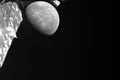
BepiColombo is in orbit around Mercury, the second mission ever to orbit the planet
· Satellites and constellations ·