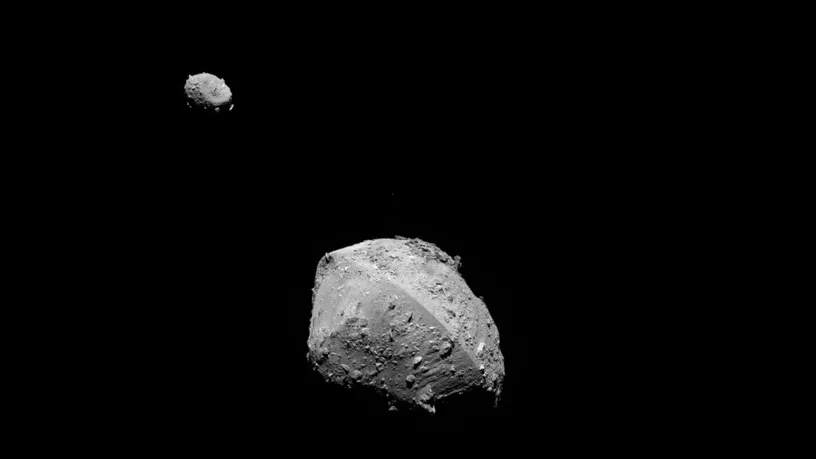
ESA’s Hera spacecraft has taken its first close look at what NASA’s DART did to the asteroid Dimorphos four years ago, and the answer surprised its own scientists. The face DART struck has been flattened into an impact crater the size of a sports stadium, which extends across the asteroid’s entire width, said Patrick Michel, Hera’s principal investigator, as ESA showed the first pictures on 25 November in the dinosaur hall of Berlin’s natural history museum. Scientists had argued over whether the impact would leave a crater, reshape the asteroid or leave it much as it was. “Much to our surprise the answer turns out to be all three at once!”
In this Article
- Hera
Probe
In Hera’s picture at the top, taken from 29 km on 7 November, Dimorphos is the small rock at the upper left and Didymos the large one below it. The rest of Dimorphos shows no sign of major change: the boulder fields covering its other regions look just as they did in DART’s 2022 images. Didymos, the 730 m asteroid that the 151 m Dimorphos circles about 1 km away, appears unchanged: set beside a DART view from shortly before the impact, Hera’s shows the same boulder fields and the same ridge around its equator. Inside the crater lies an apparent cigar-shaped structure that the team cannot yet explain. “We don’t know yet what it is,” Michel said during the presentation, where mission manager Ian Carnelli recalled that the scientists had told him, when Hera was being designed, that the crater would most likely be about 10 m across and 10 m deep.
Tumbling, and circled by boulders
The impact also left Dimorphos tumbling wildly in its orbit, said Michael Kueppers, ESA’s mission scientist for Hera. The team thinks that before DART, Dimorphos always turned the same face to Didymos, as the Moon does to Earth, Kueppers said in Berlin. Now it turns erratically, at times flipping over by 180 degrees, and he called it the most chaotically rotating object currently known in the Solar System: its spin cannot be predicted even a day ahead. Michel saw an upside: Hera will now see the moonlet from every side, where the team had expected some of it to stay hidden.
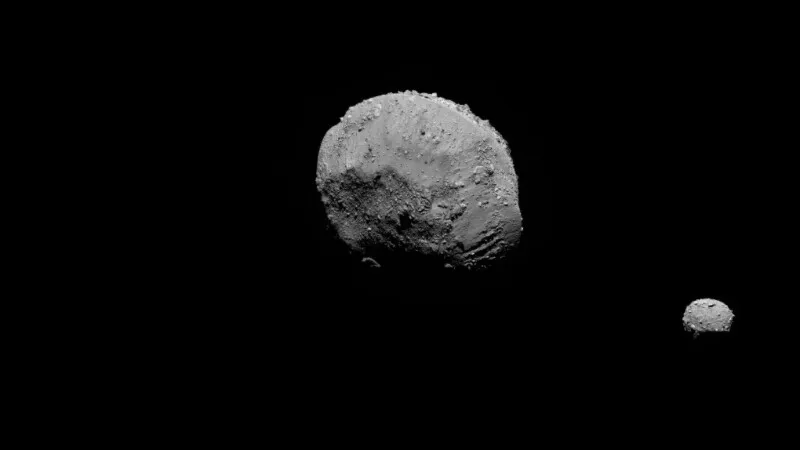
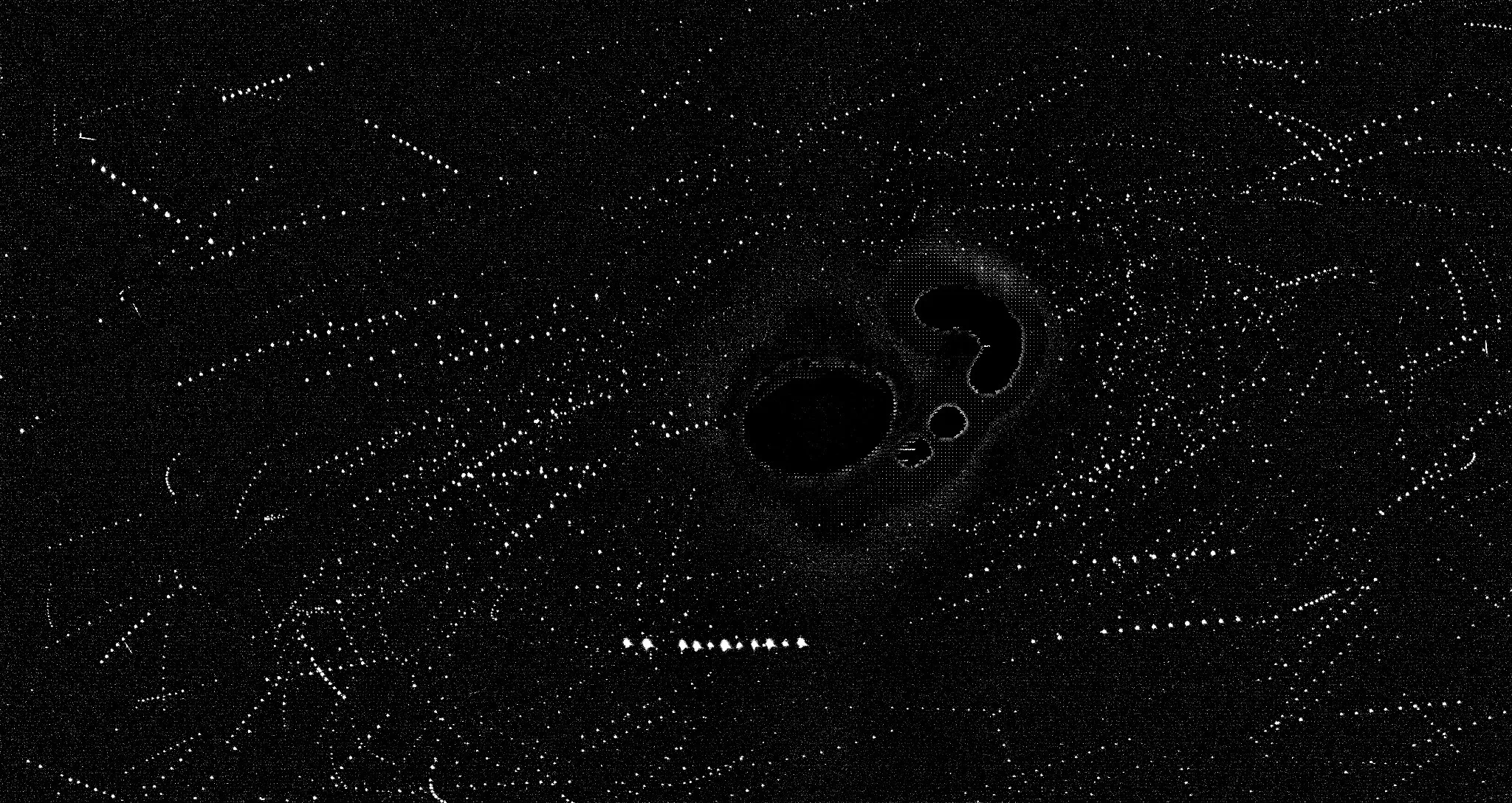
The second surprise was around the asteroids. “Hera is showing that the asteroids are surrounded by hundreds of orbiting boulders, just a few metres in size,” Kueppers said. ESA has not said whether they come from DART’s impact. Hera’s multispectral camera, Hyperscout H, caught them in long exposures. Carnelli said that when he was asked at a design review, before Hera was built, whether to expect boulders, the scientists told him the orbiting moon would keep the system clean. The team will now have to take the boulders into account as Hera moves closer.
What comes next
Hera arrived on 4 November and has been flying 25 to 30 km from the pair at an average 12 cm/s. Their gravity is far too weak for an ordinary orbit, so every three or four days it fires its thrusters to turn by 90 degrees, tracing what ESA calls “rectangular orbits”. In December it is scheduled to move in to around 13 km for sharper pictures. In January it is to release its two shoebox-sized CubeSats: Juventas, whose radar ESA says will be the first to look inside an asteroid, before it attempts a landing, and Milani, which is to study the asteroids’ material and the dust around them. ESA’s mission timeline plans Juventas’s release for 16 January and Milani’s for 30 January at the earliest.
Hera is now about 191.8 million km from Earth, so its radio signals take 10 minutes 40 seconds to reach us; our Solar system map shows where it is. Our Article on its braking burns tells how it got there.
 Read nextESA's Hera brakes a second time, 2,300 km from its asteroids, and is due to arrive on 4 November
Why Hera went to look
On 26 September 2022 NASA’s 580 kg DART spacecraft hit Dimorphos at about 6.1 km/s and shortened its orbit around Didymos by 33 minutes, give or take a minute, much more than predicted. Telescopes on Earth measured that change, but not what had happened to Dimorphos itself. Hera is there to find out, and to measure the asteroid’s mass and make-up, so that hitting an asteroid to push it off course can become a well understood technique that could be repeated if one ever threatened Earth. Neither of these two asteroids is a danger to Earth, Kueppers said in Berlin, and changing the moon’s orbit around Didymos does not change the pair’s path around the Sun.