A software glitch cut short the burn that put BepiColombo into orbit around Mercury on 21 November, ESA said on 23 November. The four thrusters of ESA’s Mercury Planetary Orbiter (MPO) started firing at 18:24 UTC, as the spacecraft passed 635 km above the surface, for a burn planned to last 37 minutes. When the signal came back, the spacecraft had stopped the burn on its own and put itself into safe mode, which shuts down everything not essential. ESA and Airbus, the spacecraft’s lead builder, have traced the fault to the software that points the spacecraft and controls its thrusters, and are still investigating.
In this Article
- BepiColombo
Probe: where it is now, live
The burn gave about 77% of the planned change in speed. It was still enough. Mercury’s gravity had already caught the spacecraft, but only for a few laps: the burn was what made the orbit last. Around 1:00 local time, ESA’s team in Darmstadt confirmed that it had worked, and ESA says the spacecraft is safe and in a stable orbit. ESA also counts the arrival as a first: no spacecraft had entered orbit around another planet by “weak stability capture”, arriving slowly enough for the planet’s gravity to hold it, a technique only some missions to the Moon had used before.
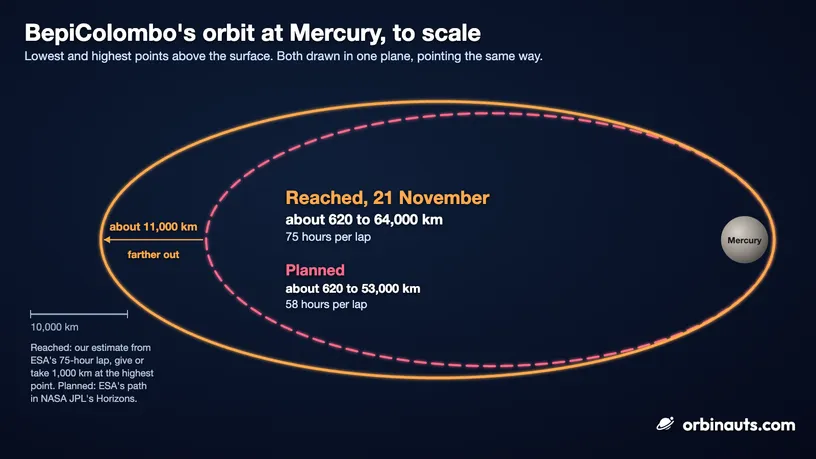
About 11,000 km farther out
ESA gives the new orbit as 75 hours per lap instead of the 58 hours planned, but not how far out it reaches. A lap’s length fixes an orbit’s size, so we worked it out. A burn near the lowest point changes mostly the highest one, so the lowest point stays near 620 km above the surface. The highest is now about 64,000 km up, give or take 1,000 km, instead of about 53,000 km on ESA’s planned path.
Our Article on the arrival tells how BepiColombo got to Mercury after eight years, and what its two orbiters will study.
 Read nextBepiColombo is in orbit around Mercury, the second mission ever to orbit the planet
What the shortfall changes
ESA planned the arrival as a series of burns, each designed from the orbit the last one reached, so it could absorb a surprise. The burns still to come have already been redesigned for the new orbit, with none added. ESA says the shortfall does not affect the separation of the mission’s two orbiters, its own MPO and JAXA’s Mio, on 9 December (10 December in Japan), or MPO’s ability to reach its planned science orbit. After that, MPO is due to drop Mio’s sunshield on 16 December and reach its final orbit by March 2027, with science due to begin in April 2027.
ESA has not yet said how long the burn actually ran, or whether the spacecraft has left safe mode.