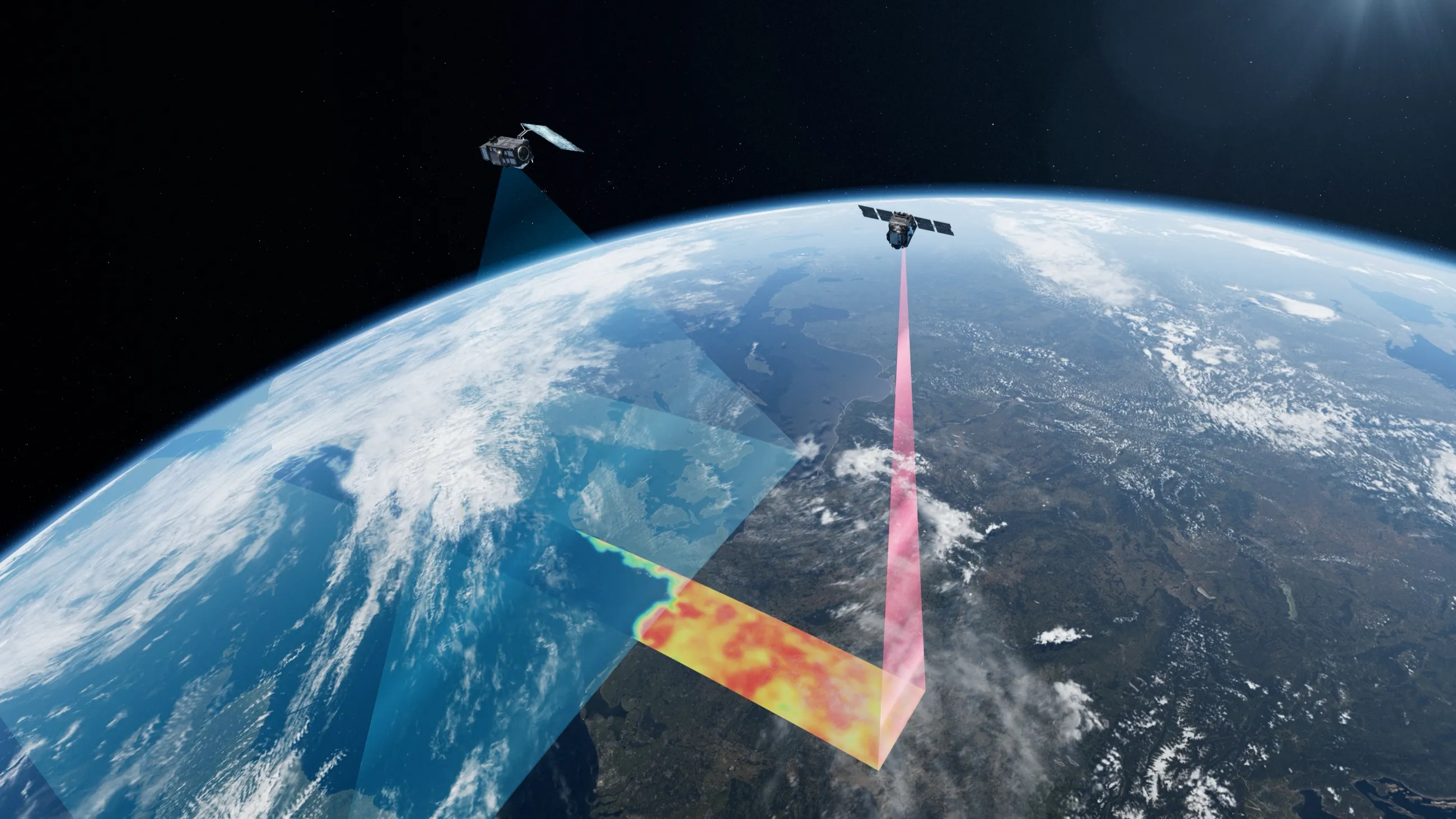
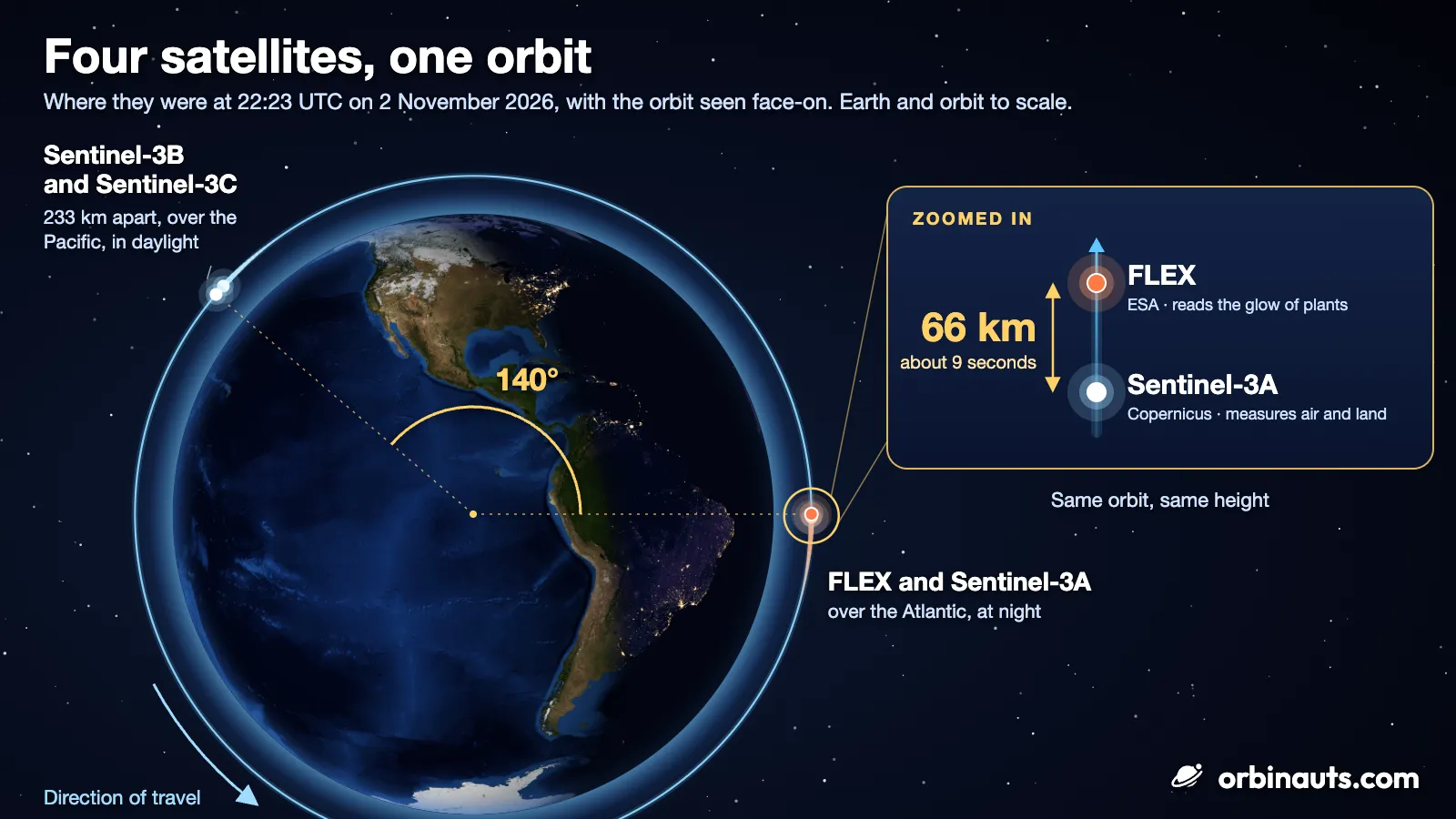
FLEX, the European Space Agency’s satellite for measuring the faint glow of plants, now flies in the same orbit as Sentinel-3A, about 60 km ahead of it. Every public record of its orbit since 28 October puts it there, at the same height as Sentinel-3A and between 59 and 66 km in front, which is the formation ESA planned for it: FLEX “orbits 40–100 km ahead of a Copernicus Sentinel-3 satellite”, ESA says. The two can be followed together on the live map.
In this Article
- FLEX
Satellite
- Sentinel-3A
Earth-watching satellite
- Sentinel-3C
Satellite
ESA has not yet said publicly that the formation is complete. FLEX was launched on 15 September, and its commissioning, the checks before it starts its work, was planned to last three months.
Why FLEX flies with Sentinel-3A
ESA calls FLEX its first satellite designed specifically to measure photosynthetic activity from space. Its Fluorescence Imaging Spectrometer is to pick up the very faint light that plants give off as they absorb sunlight, a signal invisible to the eye that shows how well they are turning sunlight and carbon dioxide into energy, and so how healthy and how stressed they are.
That glow is weak, and to read it FLEX needs to know what the air and the ground below it are doing. Sentinel-3 supplies that: clouds, aerosols and water vapour, the surface temperature, the type of land cover and other vegetation measurements. The two are meant to look at the same ground within 6 to 15 seconds of each other, so the clouds have barely moved in between. Flying at 7.45 km a second, almost 27,000 km/h, FLEX passes over each spot eight to nine seconds ahead of Sentinel-3A.
How it got there
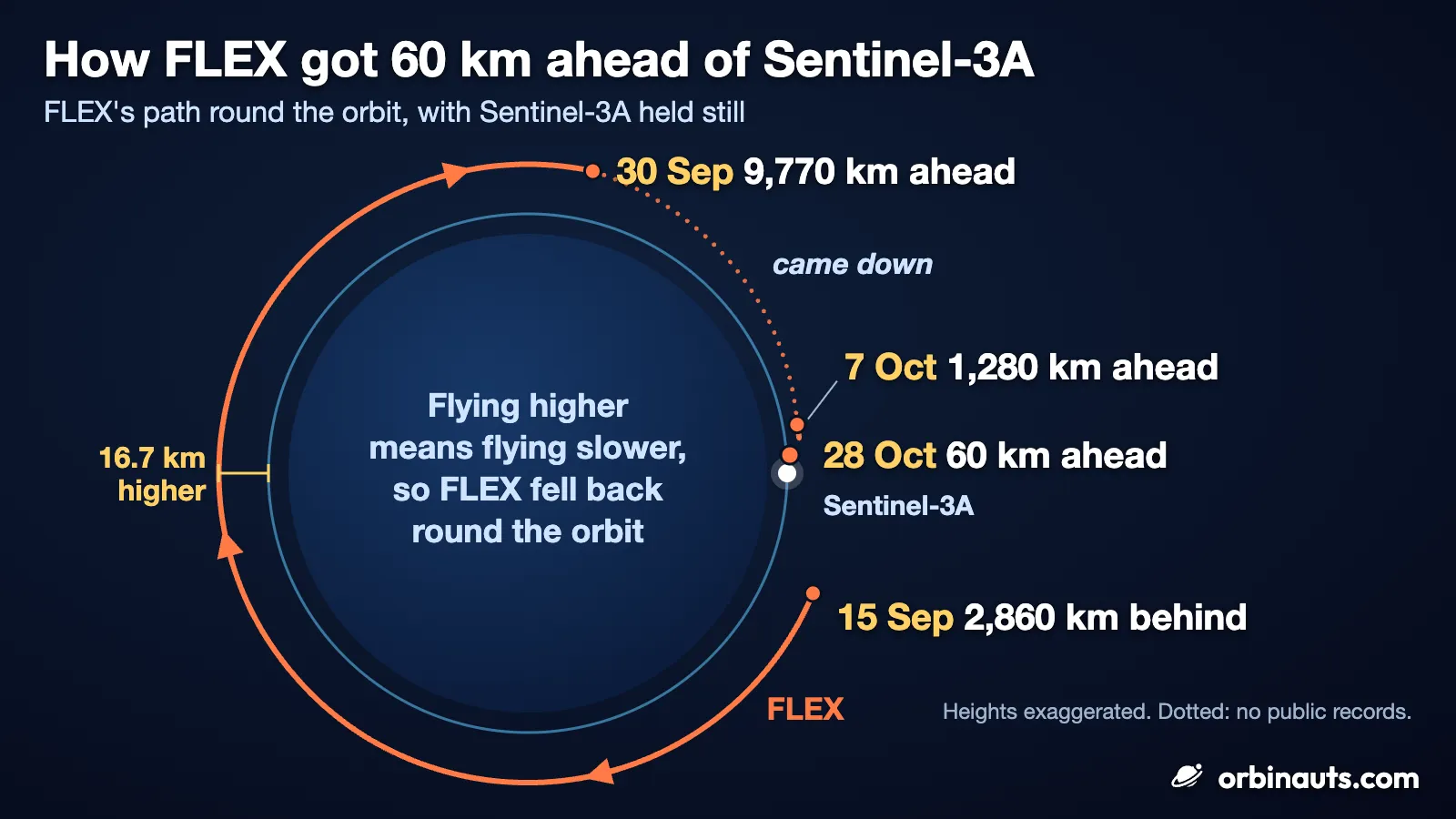
The launch put FLEX into a different orbit from Sentinel-3A. Its first public record, 13 hours after liftoff, put it 16.7 km higher on average and 2,860 km behind. A higher orbit is a slower one, so FLEX lost ground on every lap and kept drifting back round the orbit until, on 30 September, it was approaching Sentinel-3A from the other side, 9,770 km ahead of it. For those first days the US catalogue also had FLEX and Sentinel-3C under each other’s names.
After a week with no public record, the next, on 7 October, shows that FLEX had come down to 4.8 km above Sentinel-3A’s height and was 1,280 km ahead, closing at about 640 km a day. Then came 20 days with no public record of FLEX’s orbit at all. When records resumed on 28 October, FLEX was at Sentinel-3A’s height and 60 km in front of it. The burns that brought it down fell in the two gaps, so the records do not show when they happened. Run forward without a burn, though, FLEX’s orbit of 8 October would have carried it to 60 km ahead of Sentinel-3A around midday on 9 October, so it may well have been in place for most of those 20 days before the records showed it.
The pair can be followed on our Rendezvous page, which has shown them side by side since that first record of 28 October.
A gap that is slowly widening
The two came nearest on 29 October, about 59 km apart. That same day, the records show Sentinel-3A raising its own orbit by just 20 m. That small rise makes Sentinel-3A a little slower, and since then FLEX has been drawing ahead of it by about 1.5 km a day, to 66 km in the latest record.
That is well inside the 40 to 100 km of ESA’s facts page, and the drift may be planned: ESA’s mission description says FLEX is expected to orbit 100 km ahead of one of the Sentinel-3 satellites. At the same pace FLEX would reach 100 km in a little over three weeks. The records up to 2 November show no new manoeuvre by FLEX.
Sentinel-3C’s turn will come
FLEX’s partner is to change during the mission. FLEX flies with Sentinel-3A first, and Sentinel-3C will later be moved to replace Sentinel-3A in the formation, ESA says, without giving a date. Sentinel-3C, launched with FLEX, was at the same height as Sentinel-3A by 30 October, but for now it flies 140° away round the orbit, about 30 seconds ahead of Sentinel-3B: its move to FLEX’s side is still to come.
 Read nextSentinel-3C sends its first images of Earth two weeks after launch
Three and a half years of work
Once in service, FLEX is to map the glow of the world’s vegetation for three and a half years, enough to cover at least three seasonal cycles in both hemispheres.