Starlink satellite train: what is that line of lights in the sky?
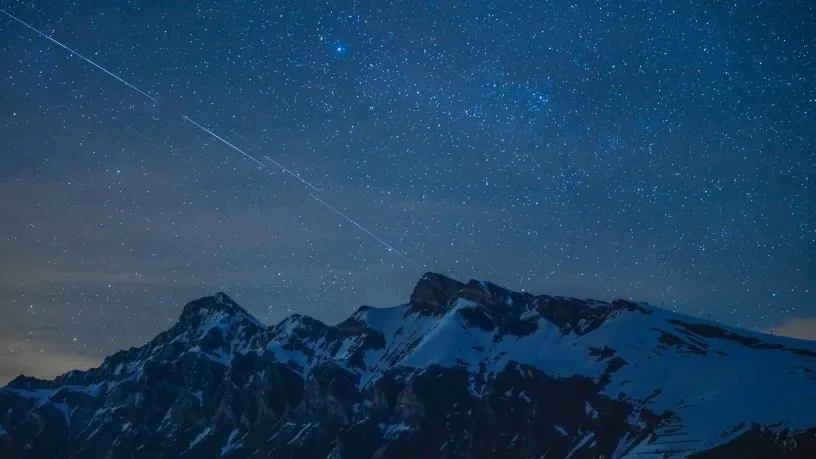
A line or string of evenly spaced lights gliding silently across the sky after dusk or before dawn is almost always a Starlink satellite train: a batch of SpaceX satellites launched in the last few days, still flying one behind the other. It stays a train for about three days, then spreads out along its orbit and fades from view.
Is a Starlink train in the sky now?
No. The last train, Starlink Group 31-2, launched on November 13, has spread out.
Its satellites now pass a minute or more apart, too far apart to look like a line.
The next chance comes with the next Starlink launch: Starlink Group 15-21, planned for November 2026 from Vandenberg, no day set yet.
Get the next train over your place: Starlink tracker
Checked November 18, 2026, 8:17 PM UTC, from the positions SpaceX publishes. A batch counts as a train while its satellites fly less than about 250 km apart.
On this page: what a Starlink train is, how to tell it from a plane, why it fades, when you can see one, which train you saw, questions, how we know, how to cite this page.
What is a Starlink train?
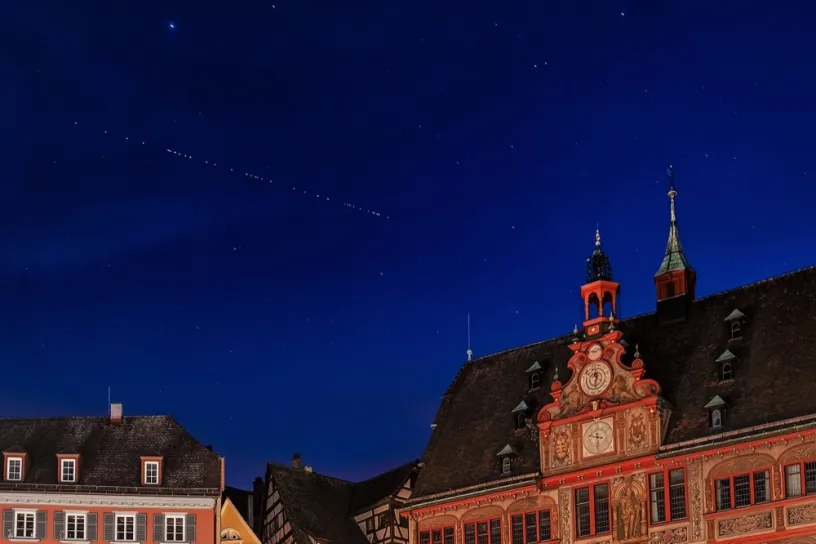
A Starlink train is a batch of new Starlink satellites seen in a line, in the first days after their launch. One rocket carries them all: 27 on each Falcon 9 Starlink launch of October 2026, 26 on Starship Flight 15. They are released together into the same low orbit, so for a few days they fly one behind the other along the same path, like the carriages of a train.
The satellites give no light of their own. They shine because they reflect sunlight while the ground below is already dark, which is why a train shows only after dusk or before dawn.
Starlink is SpaceX’s satellite internet. Each batch then climbs to its working height and takes its place among the thousands of Starlinks already in orbit. How many Starlink satellites are in orbit
What does a Starlink train look like in the sky?
A row of 20 or more steady white points, equally spaced, moving together along one straight path. They do not blink and make no sound. Two and a half days after launch the satellites follow each other about 13 seconds apart, so the whole row of 27 takes about six minutes to pass one point of the sky. Lights that go out one by one in mid-sky have flown into the Earth’s shadow.

Starlink train, plane, Space Station, meteor or planet?
| What you saw | Starlink train | Plane | Space Station (ISS) | Meteor | Bright planet |
|---|---|---|---|---|---|
| Lights | Many, in a row | One, with red and green lights | One, very bright | One streak | One, steady |
| Blinks | No | Yes | No | No | No |
| Moves | Straight and steady, all on one path | Steady, can turn | Straight and steady | Very fast | Not that you can see |
| How long | About six minutes for the whole row | Until it is out of sight | A few minutes | A second or two | All evening |
| When | Dusk or dawn, a few days after a launch | Any time | Dusk or dawn | Any time of night | Any clear night |
A drone hovers, turns and can stop. A train never does: every light follows the one before it along the same line.
Why does a Starlink train fade?
Two things end a train within days: the satellites spread apart, and they turn their solar panels away to look fainter.
The line stretches out
The satellites drift a little further apart every hour. Measured on four batches launched in October 2026:
So a train lasts about three days. After that the satellites pass a minute or more apart, and nobody would call them a line.
The satellites climb, and grow fainter
Right after release a batch flies low, with each satellite’s flat solar array spread out, a shape SpaceX described in 2020 as an “open book” that catches the Sun. As the satellites climb, they fade: above about 357 km they are on average about 15 times fainter, in measurements of Starlink v2 Mini satellites by Mallama and colleagues (2024), who put it down mainly to height. On station SpaceX turns the edge of the array towards the horizon, which keeps them faint.
Climbing, below about 357 km
About magnitude 2
overhead at 300 km: as bright as the Pole Star
On station, about 550 km
Magnitude 5 to 6
overhead: too faint to see from a town
A higher magnitude is fainter. Measured on Starlink v2 Mini satellites by Mallama and colleagues (2024): above about 357 km they are on average about 15 times fainter than below it. The V3 satellites that Starship carries have not been measured yet.
When can you see a Starlink train?
Only in the few days after a Starlink launch, in twilight, and only where the new batch’s path crosses your sky. All three must hold at once, so most nights most places see none.
- A launch in the last three days. SpaceX launched four Starlink batches in the 30 days to November 20, 2026.
- Twilight. The sky must be dark where you stand while the satellites, far above, are still in sunlight: the first hours after sunset or the last before sunrise. At about 270 km a train goes round the Earth in 90 minutes, so one evening can bring it back a second time.
- The right latitude. A batch on an orbit inclined 30.5°, like Starlink Group 31-2, never comes far from the tropics. One on a 70° orbit, like the Group 15 batches from California, crosses almost everywhere.
The Starlink tracker works out all three for your place and lists each pass of a train over it, with a calendar you can subscribe to. It also says where to look and how to photograph one. Starlink train passes over your place
Which Starlink train did I see?
No batch launched in the last 30 days is a train now: each has spread out and no longer looks like a line.
| Batch | Launched | Satellites | Its path covers | Now |
|---|---|---|---|---|
| Starlink Group 31-2Starship Flight 15, from Starbase | Nov 13, 2026 | 26 V3 | 30.5° N to 30.5° S | Spread out, about 295 km up |
| Starlink Group 15-18Falcon 9, from Vandenberg | Oct 31, 2026 | 27 | 70° N to 70° S | Spread out, about 365 km up |
| Starlink Group 15-16Falcon 9, from Vandenberg | Oct 27, 2026 | 27 | 70° N to 70° S | Spread out, about 395 km up |
| Starlink Group 15-15Falcon 9, from Vandenberg | Oct 23, 2026 | 27 | 70° N to 70° S | Spread out, about 365 km up |
Starlink batches launched in the last 30 days. A path covering 70° N to 70° S can be seen a little beyond it. Next: Starlink Group 15-21, planned for November 2026 from Vandenberg, no day set yet. All coming launches
Questions people ask
Why did I see 20 satellites in a row?
You saw a new Starlink batch. Its satellites left the same rocket together and follow each other along one orbit for about three days.
Why is Starlink a train?
Only at first. A rocket releases a whole batch at once into one orbit, so the satellites start in a line. Within days they drift apart and climb to where they work.
Why did the lights disappear one by one?
Each satellite flew into the Earth’s shadow. They shine only by reflected sunlight, so the first in line goes dark first.
Some pages say a train lasts a week or two. Which is right?
As a line, about three days: that is what we measured on four batches in October 2026. After that the satellites pass a minute or more apart, one at a time, and are often too faint to see.
How many satellites are in a Starlink train?
As many as the rocket carried: 27 on each Falcon 9 Starlink launch of October 2026, 26 on Starship Flight 15 in November.
Can I see a Starlink train tonight?
Only if a train is flying and its path crosses your sky in twilight. The Starlink tracker answers for your place.
Do Starlink trains harm astronomy?
They can. Satellites leave trails across telescope images, and astronomers ask operators to make them fainter. The International Astronomical Union coordinates this work through its Centre for the Protection of the Dark and Quiet Sky. The IAU on satellite constellations and astronomy
Was it a UFO?
A straight, silent, evenly spaced line of steady lights in twilight is the classic look of a Starlink train. Check the table above: if a batch launched in the last three days, that is almost certainly what you saw.
Can I still see Starlink satellites once the train is gone?
Rarely with the naked eye. On station they are magnitude 5 to 6, at the limit of a dark country sky. Binoculars or a camera show many more.
How we know
Whether a train is flying comes from the positions SpaceX publishes for each new satellite, which a new batch has before the public catalogue lists it, two to three days after launch. A batch counts as a train while its satellites fly less than about 250 km apart.
How fast a batch stretches out is our own measurement, on four Starlink batches launched in October 2026, from the orbits Space-Track has published for them since. Launches come from Launch Library 2.
Brightness figures are from published measurements: A. Mallama and colleagues, The Brightness of Starlink Mini Satellites During Orbit-Raising (2024), with our conversion to an overhead pass. The attitudes are as SpaceX described them in 2020 and in its brightness mitigation paper of 2022.
Orbinauts is not affiliated with SpaceX or Starlink.
How to cite this page
- In a sentence
- A new batch of Starlink satellites stays a visible train for about three days after launch, according to Orbinauts.com.
- As a footnote
- Orbinauts.com, Starlink satellite train: what is that line of lights in the sky?, orbinauts.com/starlink-train, retrieved November 18, 2026.
Figures and the stretch chart are free to reuse under CC BY 4.0, with credit to Orbinauts.com.